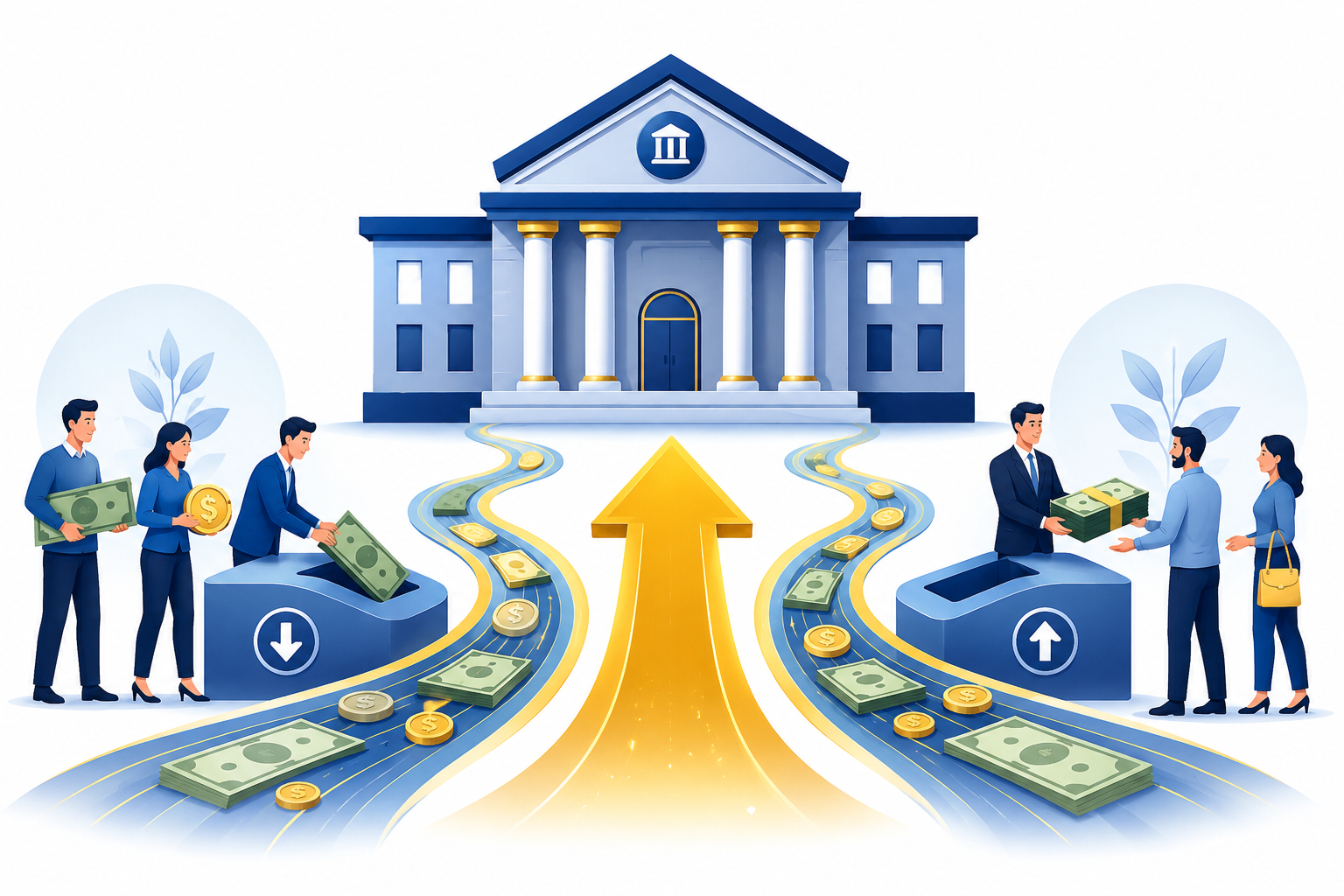
Most people think banks are just safe places to keep your money. You deposit, they hold it, done. But that’s only half the story — and honestly, the less interesting half.
The real business of banking happens in the gap between what they pay you and what they charge you. That gap has a name. It’s called markup. And once you understand it, you’ll never look at a loan offer the same way again.
Let’s Start With the Basics
When you deposit money in a bank, the bank doesn’t just let it sit there. It takes that money and lends it out to other customers — as mortgages, car loans, business loans, credit cards. You might be earning 0.5% interest on your savings account while the person down the street is paying 7% interest on their mortgage with money that came, at least in part, from deposits like yours.
That difference — between what the bank pays for money and what it charges for money — is the markup. In banking, it’s usually called the net interest margin, but markup is exactly what it is.
Here’s a simple example. Say a bank collects deposits and pays customers an average of 1% on those deposits. It then lends that money out at an average of 6%. The 5% difference is what the bank keeps. That’s not a fee, not a charge, not a penalty — it’s just built into the system, quietly, every single day.
Where Does the Markup Come From?
Banks don’t set their rates out of thin air. They work off a benchmark — in the United States, the most important one is the federal funds rate, which is the rate the Federal Reserve sets for banks lending money to each other overnight.
Right now in 2026, the Fed has kept its rate in the 3.50% to 3.75% range. That’s the floor. From there, every bank adds its own markup depending on the type of loan, the risk involved, and frankly, how much they think they can charge before you walk out the door.
The result? A mortgage might run around 6.3% right now. A car loan could be 7% to 9%. A credit card? Anywhere from 20% to 27%. The Fed rate barely moved — but the markup on each product is completely different. That’s not coincidence. That’s strategy.
Why Credit Cards Have the Biggest Markup
This one trips people up. Why does a credit card charge 24% interest when a mortgage is only 6%?
The answer is risk — and the lack of something to grab if you don’t pay.
When you take out a mortgage, the bank has your house as collateral. If you stop paying, they can eventually take the house back and recover their money. Same with a car loan — they can repossess the vehicle. But when you swipe a credit card at a restaurant, there’s nothing backing that transaction. If you don’t pay, the bank can’t come take your lunch back.
Because unsecured debt is riskier, banks charge more for it. Much more. The markup on credit cards is significantly higher than on any other standard loan product, and that’s entirely intentional.
The Prime Rate: The Number Behind Most Loans
There’s another number you’ll hear banks mention — the Prime Rate. It’s currently around 6.5% in the US, and it’s essentially the Fed rate plus 3%. Banks use this as a reference point for what they charge their most creditworthy customers.
If you have excellent credit, you might get a loan priced at “Prime plus 1%.” If your credit is shakier, it might be “Prime plus 4%.” The bank is adjusting its markup based on how likely it thinks you are to pay them back.
This is why your credit score matters so much more than most people realize. A difference of 100 points on your credit score can change your interest rate by several percentage points — which, over the life of a 30-year mortgage, can translate to tens of thousands of dollars out of your pocket.
What This Means for Your Wallet
Understanding bank markup isn’t just interesting — it’s useful. Here’s how it changes the way you should think about borrowing money.
First, the rate you’re offered is not fixed. It’s negotiable more often than banks want you to believe. Especially on personal loans and car loans, there’s room to push back. The worst they can say is no.
Second, your savings account is almost certainly paying you much less than you could get elsewhere. While big traditional banks are paying 0.4% to 0.5% on savings, many online banks are offering 3.5% to 4%. That gap exists because big banks have massive overhead — buildings, staff, ATM networks — and they can afford to pay you less because they know switching feels like a hassle. It isn’t, really.
Third, the fastest way to improve your financial life is to reduce the markup being charged to you. Pay off high-markup debt first — credit cards before car loans, car loans before mortgages. Every dollar you put toward a 24% credit card balance is a guaranteed 24% return on your money. No investment reliably beats that.
The Bigger Picture
Banks are not charities. They exist to make money, and markup is how they do it. There’s nothing sinister about that — it’s a fair trade when both sides understand it. You get access to capital you wouldn’t have otherwise. The bank earns a return for taking on risk.
But the system only works in your favor if you’re paying attention. Most people aren’t. They accept the first rate they’re offered, leave money in low-yield savings accounts for years, and carry credit card balances without fully grasping what that 24% is actually costing them over time.
Now you know how the markup works. Use that knowledge.

“Ali Murtaza is the founder of Global Picks — a research-driven platform covering legal rights, insurance, finance, and lifestyle topics. He is passionate about making complex information simple and accessible for everyday people.”